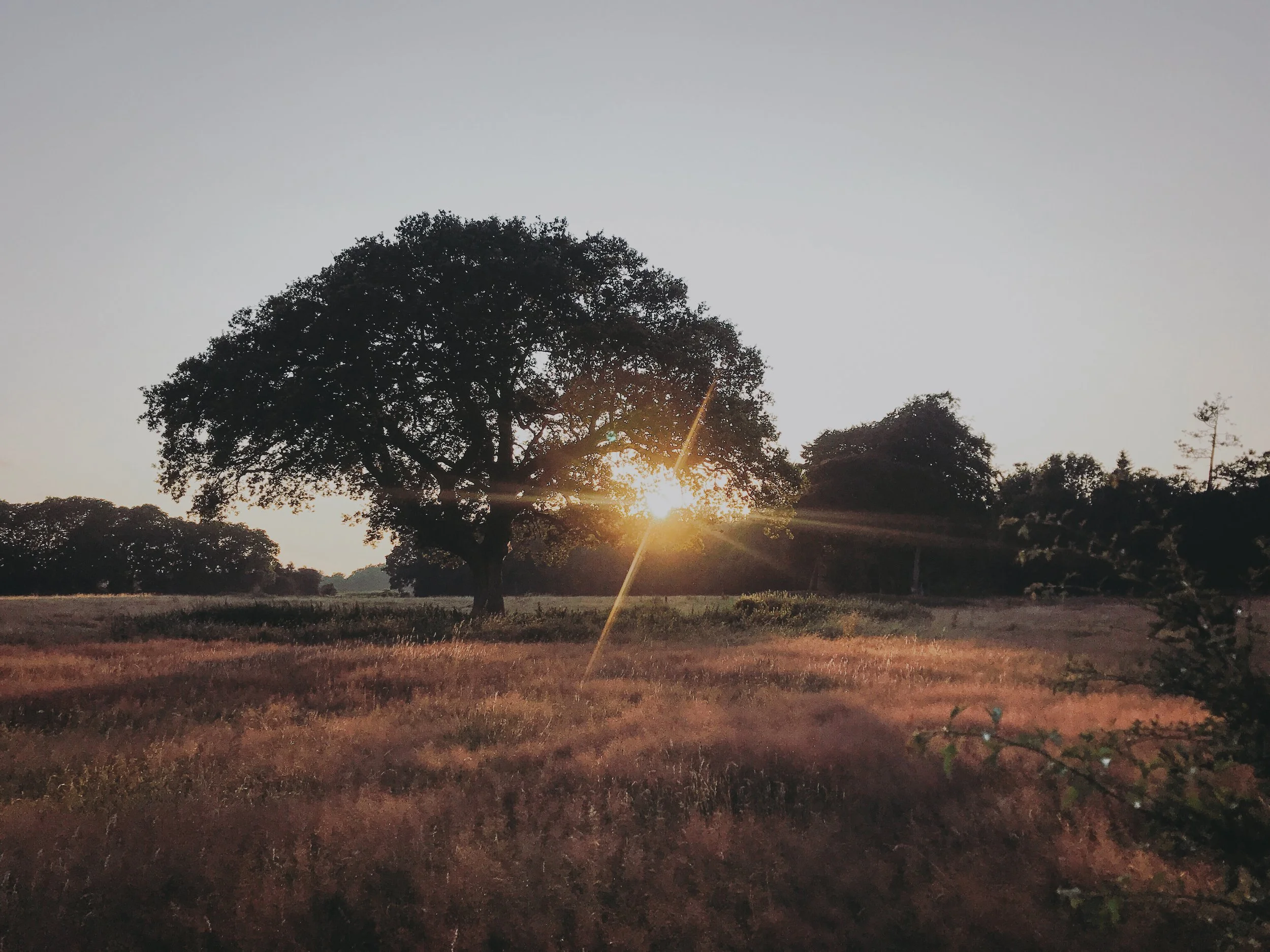
There are presences in life that do not announce themselves. They do not arrive with urgency or leave with ceremony. They remain. And sometimes it is only in their absence that their shape becomes clear. For me, it’s often trees.
The eucalyptus outside our window, tall, slightly unruly, lets me know it’s there in the wind, shedding bark in long curls as if forever becoming itself again. Elsewhere, a lychee tree older than memory, which I greeted each morning in Asia, holds its place in the day as if time were something it could rest inside. In the small, everyday crossings of daily life, the parks I run in, the streets I navigate, the edges of things, trees appear again, not as interruption, but as continuation.
Maybe it’s no accident that every year my reading list fills with books about trees. I’m drawn to covers that carry their silhouettes: branches against sky, roots against earth. Something in me recognises something in them. Perhaps it’s living in London and finding a way to reach nature quietly, to seek stability and grounding in the bustle.
When I feel unmoored, I look for a tree. Not poetically, bodily. My breathing changes. My shoulders drop. Their rootedness steadies something ancient in me.
I’ve noticed how certain images do this for me, and for those I work alongside, opening space where words alone cannot. In rooms where trauma often lingers, or is only circled around, images like trees allow something to move, something unspoken that explanations or solutions cannot reach.
Perhaps this is because they offer a form that does not demand resolution, they do not suggest that damage must be undone, only that it can be lived with. A body can hold both rupture and continuation without needing to choose between them. But maybe it’s simpler than that: trees give us a language for things we don’t yet have words for. They let us see our own scars without shame. They show us that damage and growth can exist in the same body. We recognise ourselves in them.
Trauma is notoriously difficult to speak about directly. It doesn’t sit neatly in narrative. It lives in sensation, in silence, in the quickening of the heart or the tightening of the chest before the mind has caught up. As Bessel van der Kolk writes “the body keeps the score.” What happens to us doesn’t simply become a story we can tell; it becomes something we carry, something that shapes how we move through the world. And in their own quiet way, trees remind us that rupture does not mean the end of life, it becomes part of it.
Generations Written in Wood
Trees do not hide their history. Beneath the bark, their rings hold everything: years of drought, of abundance, of damage, of regrowth. Nothing is edited out. Nothing is rushed past. Each layer remains, not as a burden, but as part of the structure that allows the tree to stand.
Gabor Maté reminds us that trauma is not simply what happens to us, but what happens inside us as a result. And what happens inside us rarely stays contained. It shapes how we attach, how we respond, how we lead, how we love. These patterns don’t begin and end with us either. Research into intergenerational trauma shows how stress responses and emotional patterns can echo across generations, carried not just in story but in biology. Like rings in wood, they accumulate, often unseen, yet deeply influential.
What is not given space does not disappear. It settles elsewhere and surfaces unexpectedly, we only have to look at the daily news, our social media feeds, at men in football stadiums. In moments where the body overrides learned restraint, or seizes the rare places where it feels safe enough to express.
In much of our culture, there is a tendency to smooth over imperfection, scrub away grime, prioritise efficiency over presence, and move quickly past discomfort. But the truth of our experience, of trauma, memory, and life, cannot be erased or hurried. Like trees that carry their scars with quiet dignity, it lingers, waits, and asks to be recognised, reminding us that presence, attention, and care are what support life to be fully lived.
Elif Shafak, in the book The Island of Missing Trees, describes this through the image of resin: thick and translucent, seeping from a wound in the bark. It protects, it preserves, but it also hardens over time. Unless something interrupts it, it continues to shape what comes next.
In my organisational trauma work, we are often called in after a crisis, moments that divide time into before and after. And when I step into those spaces, I can feel how time no longer moves in a straight line. It folds. A response to what is happening now is often entangled with something from years ago. A reaction that seems disproportionate suddenly makes sense when seen through the lens of what came before. The body does not separate the past from present as neatly as the mind would like. It responds as if everything is happening at once. Fight, flight, freeze, held mid-motion. Something in the system is paused, waiting for conditions that allow it to move again.
And this is where this intervention becomes important. Trees are not solitary. Beneath the soil, they are connected through vast networks, sharing nutrients, sending signals, supporting one another. A forest is not a collection of individuals but a living, relational system. And so are we.
So when we work with people after a crisis, the aim is not to fix them. It’s to restore connection, to create enough safety for the nervous system to settle, for something held in place to begin to move again. Because what remains unspoken tends to harden. But what is witnessed, gently and without rush, can begin to soften. The resin starts to flow again.
Trees offer without asking: shade, shelter, oxygen. They stand through changing seasons without recognition or reward, and still, they continue. Perhaps that is part of what draws me to them. They embody a way of being that holds both vulnerability and strength without contradiction. They bend. They scar. They lose branches. And still, they grow in the dark and light.
Healing, I’ve come to believe, is not about returning to who we were before something happened. It is about integrating what has happened into who we are becoming. A tree does not erase the place where a branch once was. It grows around it. The wound becomes part of the grain, not hidden, not denied, but included.
This work, whether in therapy rooms, team meetings, or around the dinner table with your children, isn’t about control. It’s about space. About allowing complexity without rushing to resolve it. About trusting that living systems, when given the right conditions, move toward life. You don’t have to force growth; you simply create the environment, and something begins.
It reminds me of places I’ve visited where trees are treated not as objects, but as beings: vibrant silk tied around trunks, offerings left without expectation, words spoken to them rather than about them. In both life and nature, growth comes from care, attention, and respect, not from trying to push or manage.
Trees remember. And we do too. Not only the pain, but the ways we adapted, the ways we kept going, often without even realising it. The quiet resilience that doesn’t announce itself but is there nonetheless. I see trauma like this, not as evidence of something broken, but as evidence that something survived.
We are not broken systems. We are living ones. Carrying rings we didn’t choose, patterns we didn’t begin, roots we did not plant. And still we continue, unevenly, imperfectly, but persistently, holding the possibility of hope.